
Darren McDaniel: Prepared to Be Prepared
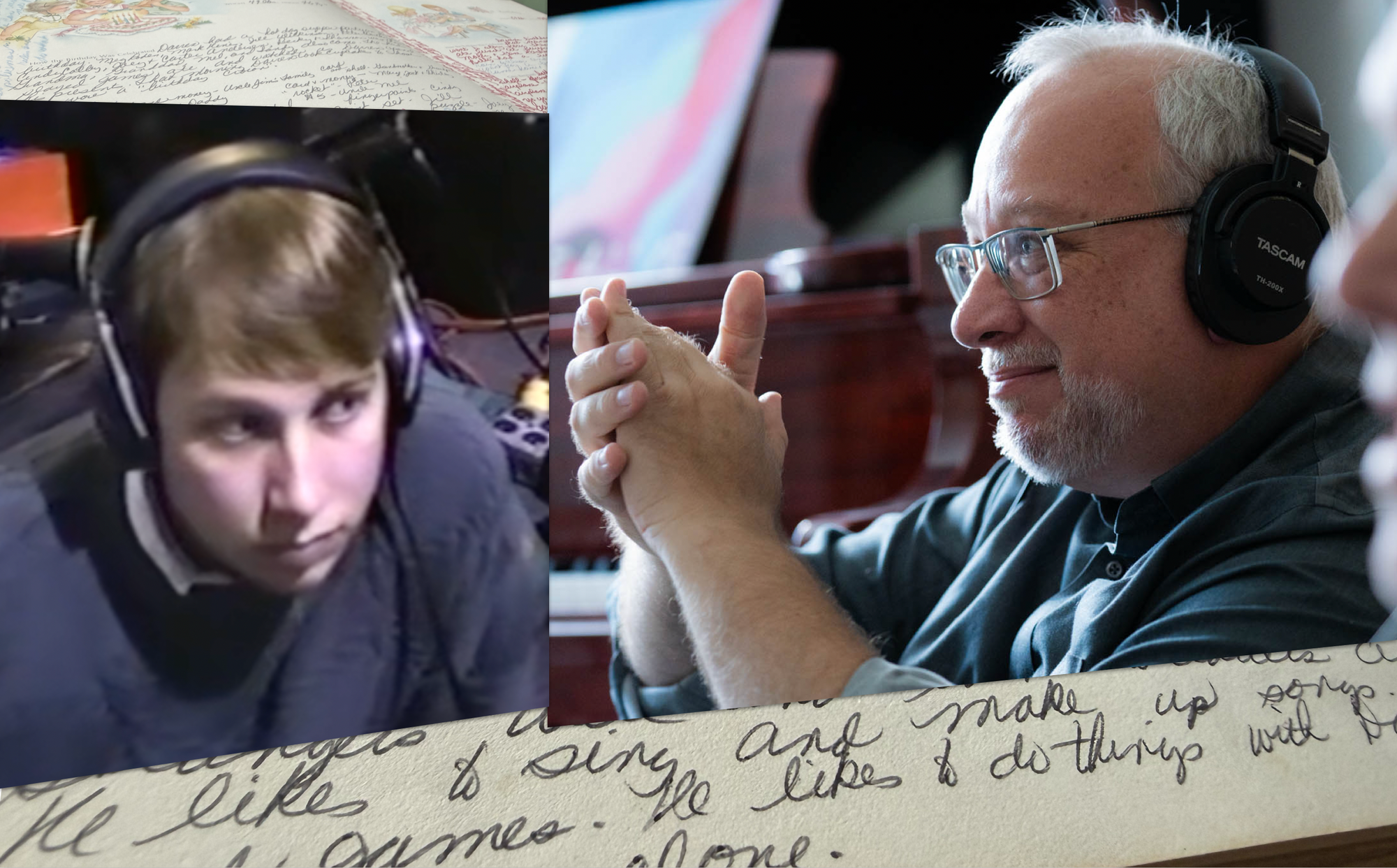
A lifelong storyteller--activated as a playwright, songwriter, filmmaker, designer, educator, sociologist, and builder of connective experiences--encountered a subject that unexpectedly demanded every part of him at once. Even among those who know him well, WIN may have appeared to arrive suddenly. In retrospect, preparation had been underway for decades: in childhood performances and creations; along subject-priming life experiences; on stages and film sets; in classrooms and community spaces; through years spent studying how people, institutions, and stories shape one another; and in a habit of finding possibility in people and moments others might pass by.
WIN gathered the threads of his life into a work that calls upon them all.
Darren and the Road to WIN
If the spirits of Gerald and Betty Ford were to turn the tables and write a musical about Darren, they might start, as he often does, with "What if...?"
A life marked by posits of possibility. Boundless capacities for wonder, willingness to try, quests toward optimal, developing imagined visions into developed realizations. What if it all came together within that life? And how. Connectively. Earnestly. Across forms and disciplines. Prolifically. Imperfectly. Resiliently.
Dramaturg: "Darren's a character who's intensely deliberate yet playful and prone to the whimsically absurd. He loves to lead and to learn and to listen. Independent minded, community spirited. Collegial but also loves his solitude. He's the kind of guy who could back-channel mull for hours--days, even--and suddenly latch onto something and see it through, relentlessly, to its against-the-odds completion. He turns 'What ifs' into things others can enter."
Gerald: "Is he 'Unremarkably remarkable?'"
Betty: "That'll be for the audience to decide."
Act I: Prepared
The notion of WIN may have surfaced on a road trip, yet the journey was one of a lifetime.
A way-making dramatist from the start--or by four, anyway. Darren's baby book mentions his overcoming being relegated to his room by chalking "E-X-I-T" on the door and using it, accordingly. Call it an early sign.

Musical composition started a couple of years earlier, highlighted by a self-accompanied grand piano homage to a popular circular pasta. By 5, his mother had compiled sufficient evidence to scribe: "He likes to sing and make up songs."
In subsequent childhood years, family gatherings often saw Darren organizing his sister and cousins for costumed, staged performances.
As the Fords were getting accustomed to the White House, Darren and his sister were readying their home theatrics (Super-8 film, silent).
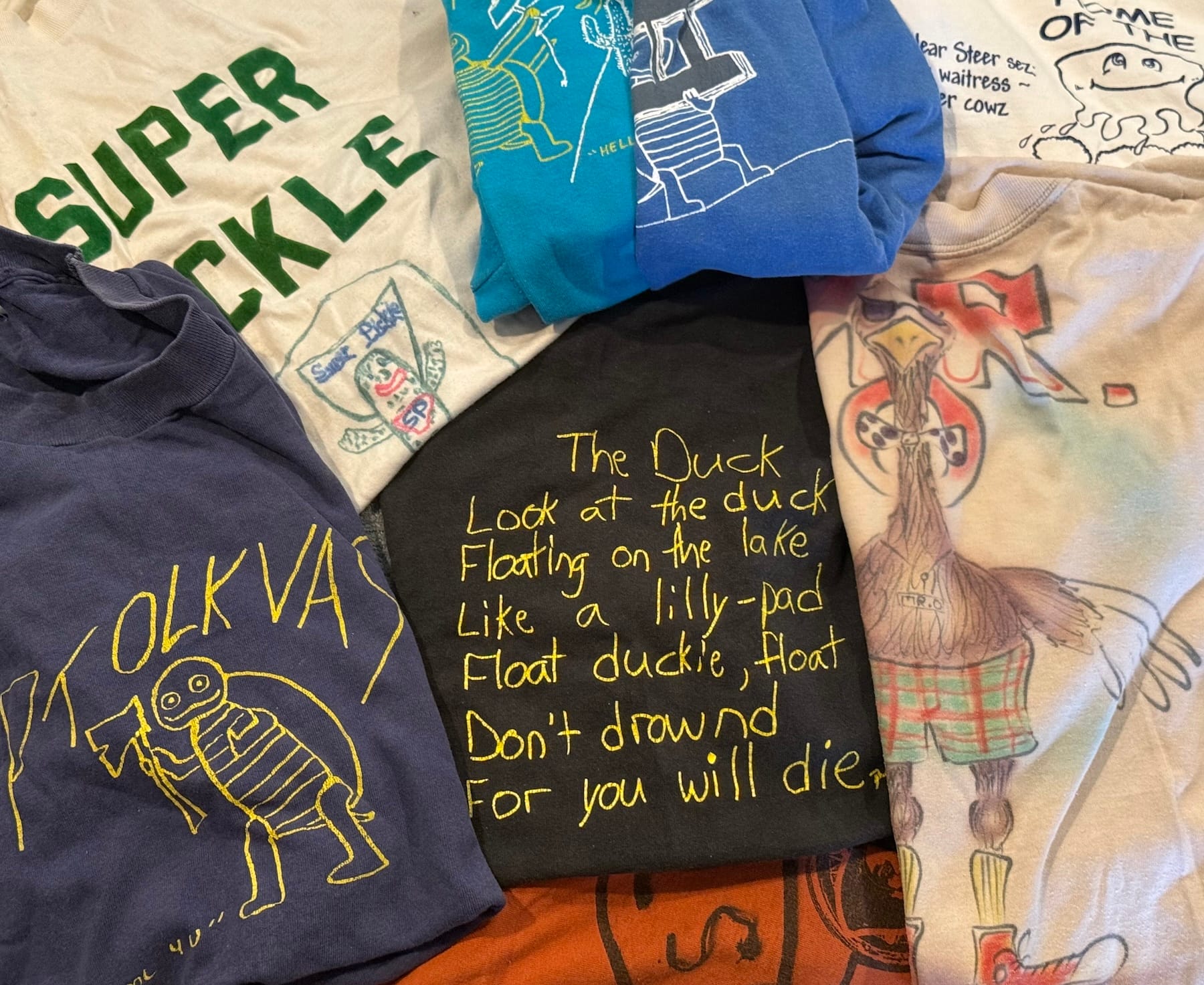
In third grade, he designed his first character, a heroic pickle, and enlisted a friend's drawing (and velvet block letters) to fashion a T-shirt. He also won an essay contest ("Why I Want to Be on The Electric Company"), and got to appear on TV--not quite The Electric Company but at least its local PBS channel. In fifth grade, he teamed with a collaborator to script his first play: a puppet show comedy about Ark animals. The year prior, he'd early-peaked his performing career as an instrumentalist, rocking an autoharp in the school holiday pageant.
Despite his mother's generous encouragement, Darren never took music lessons growing up, though he "had an ear." From sixth grade on, the family's newly-acquired piano still got plenty of exercise, as he pecked out melodies of songs he enjoyed--many of his own invention. The family's dulcimer received similar treatment. With both, his explorations rarely advanced to chords or coordinated hands.
The Fords, in their "Darren musical," might find ways to represent his love of the popular music of his early-childhood '70s--and how deeply those car-radio tunes remain embedded in his memories of the occasions in which he heard them. Most often these were family trips or riding in his father's work van. Both bonded him to music appreciation--and to so many of the particular songs that would make their way into WIN's "Spirit of 19(76)" medley.
His first record store purchases: Rupert Holmes' "Escape (Pina Colada song)" and Kenny Rogers' "Coward of the County." The Sugar Hill Gang's "Rapper's Delight" was his first album-sized purchase. Nearly all of its lyrics remain mostly burned into his memory bank. In middle school, he acquired his own stereo, and America's Top 40 became weekly appointment listening for several years. He can recall championing the rise of songs like Grover Washington, Jr's, "Just the Two of Us," Neil Diamond's "America," "Slow Hand" by the Pointer Sisters, and just about anything by Journey.
A 1981 trip to Washington, DC conflated national landmarks with the sounds of "Stars on 45," the latter planting the seed for his later embrace of Weird Al's polka medleys...and the added magic of cross-genre mash-ups. Later collection-add favorites: Human League's "Fascination." Level 42's "Something About You." Most-played album: Purple Rain, backward masking and all. Generation MTV. Video filled the radio stars, adding conceptual directions, visual theatrics, and character dynamics. Single grand interpretations left less to the imagination but widened music as an experience, exposing artistic expressions which, themselves, expanded the imaginative horizon.
Broadening imaginative horizons--for self and others--would be a through-line. Back to the '70s, Darren's foundational arc would also hold a place for his most amazing childhood experience: attending NASA's open house exhibition of the nearby Kennedy Space Center. Multiple times. Open wide for the Bicentennial, with promise that they'd only do such a thing every hundred years...and calculations for how long he'd have to stretch past a reasonable life expectancy just to get to experience such a thing again. 1976. Marveling among the astronauts. Considering the expanses of time and space. Marginally aware of the pending presidential election. Primed to find added delight when encountering an unexpected astronaut across the country, 47 years later, outside another public place.
Darren grew up alongside Disney World, closely proximate in time and space. He connected specifically with Disney's Carousel of Progress--not so much for its surface content but for what it represented. Innovation. Perspective. Progression of eras. Projections of futurecasting. The magic of space-shifting--even in experience design--as the audience circuited the full four-stage cycle without ever leaving their seats.
He loved attending local theatre and still recalls the resonance of experiencing shows like Fiddler on the Roof, Oliver, and South Pacific--especially the way in which they pulled local talents together and gave them opportunities to shine. He performed on stage in young people's theatre and then stepped up to community theatre his senior year, cast in Mr. Roberts, where his instance of ill-preparedness upon realizing he'd forgotten a key prop on stage continues to eclipse fonder memories, such as leading a goat through the audience. (Present-day epiphanies bring him an added layer of delight, as Mr. Roberts directly parallels--in timeline, branch, and location--Gerald Ford's WWII naval service in the Pacific fleet--though that's more of an Act II matter.)
High school brought character T-shirt 2.0, this time an air-brushed ostrich with its own crowd-sourced fan club roster that circulated during classes, stretched for pages, and included any notable figure (Gerald Ford?) he or any of his peers wished to add.
Long before senior-year recognition as a writer of earnest, empathetic short stories, Darren trained his creative bent toward self (and friend-circle) amusement. Absurdist poems. Setting up Candid Camera-style scenarios--more to prompt reactions than be captured or even witnessed. Audio-taped sketches, again: audience-optional. Until that one day, when his 10th-grade English teacher played the wrong side of his cassette-recorded assignment...and found it entertaining enough to share, in full, during another period's class. "Most creative student I'd ever had," the teacher would later say. Nevertheless, Darren's love of math, problem-solving, and ergonomic efficiencies steered his continuing education strategy toward universities with Industrial Engineering...and an ultimate college selection that also had room to pivot.
"Goodbye, family... 🎶"
While WIN spotlights Ford's "Decision" to pardon Nixon, Darren's "decision" of greatest impact--as addressed in his TEDx talk (end of page)--was his unorthodox choice, as an entering engineering student, of Northwestern's Communications Residential College as his dorm.
Shifting from small town Florida to Chicago's dynamic expanse was monumental, but it was his chosen dorm--a Utopian blend of talents across the creation and communication spectrum, under one roof, with access to equipment, collaborative spaces, and a wealth of spirited opportunities--that kept him at Northwestern, also sparking a prompt and definitive change of major, to Radio-TV-Film.
Capturing his CRC experience in a musical number would likely call for a "Stars On" medley. It would no doubt feature a shining moment a few weeks into freshman year, when Darren and his still-close friend, himself an Eagle Scout from Oklahoma, would spend a weekend night composing "The Country Rap," unwittingly preparing to be prepared for the dorm's as-yet-unannounced talent show. Here, their Casio-percussion-backed performing debut ("I'm Buck McD. I'm Farmer Brown. We're gonna tell y'all bout plowin' ground") hyper-charged their introduction across the dorm and set in motion a four-year odyssey marked by collaborative culture-crafting contributions.
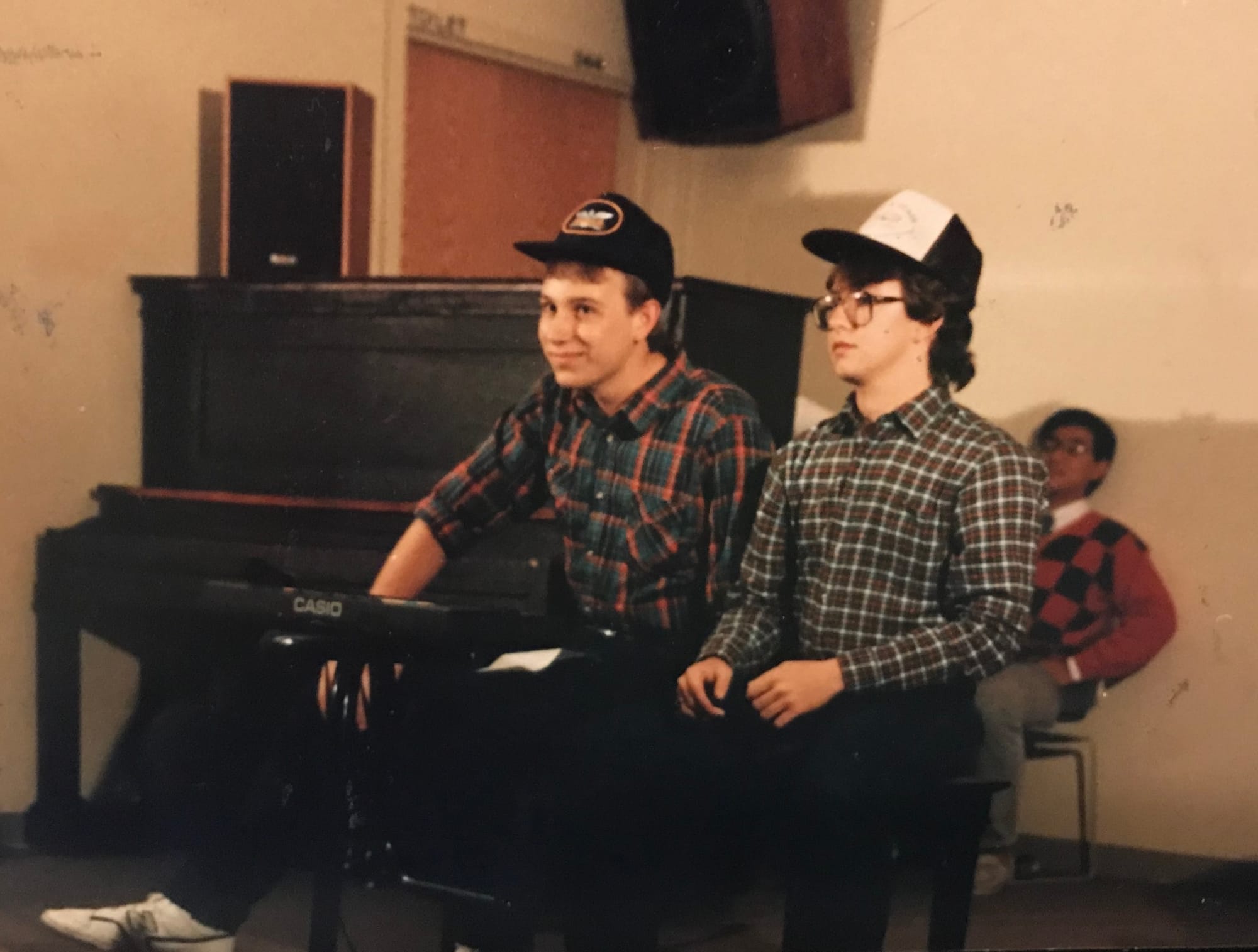
Soon to follow: More T-shirts (Front: hatchet-wielding turtle; Back: absurdist poetry; Later: annual variations; Picture: further below). More antics. More audio tapes (the dorm had its own radio station). Now video, too. And, in accord with his new major, a progression of epic extracurricular productions that would drive him through to graduation.
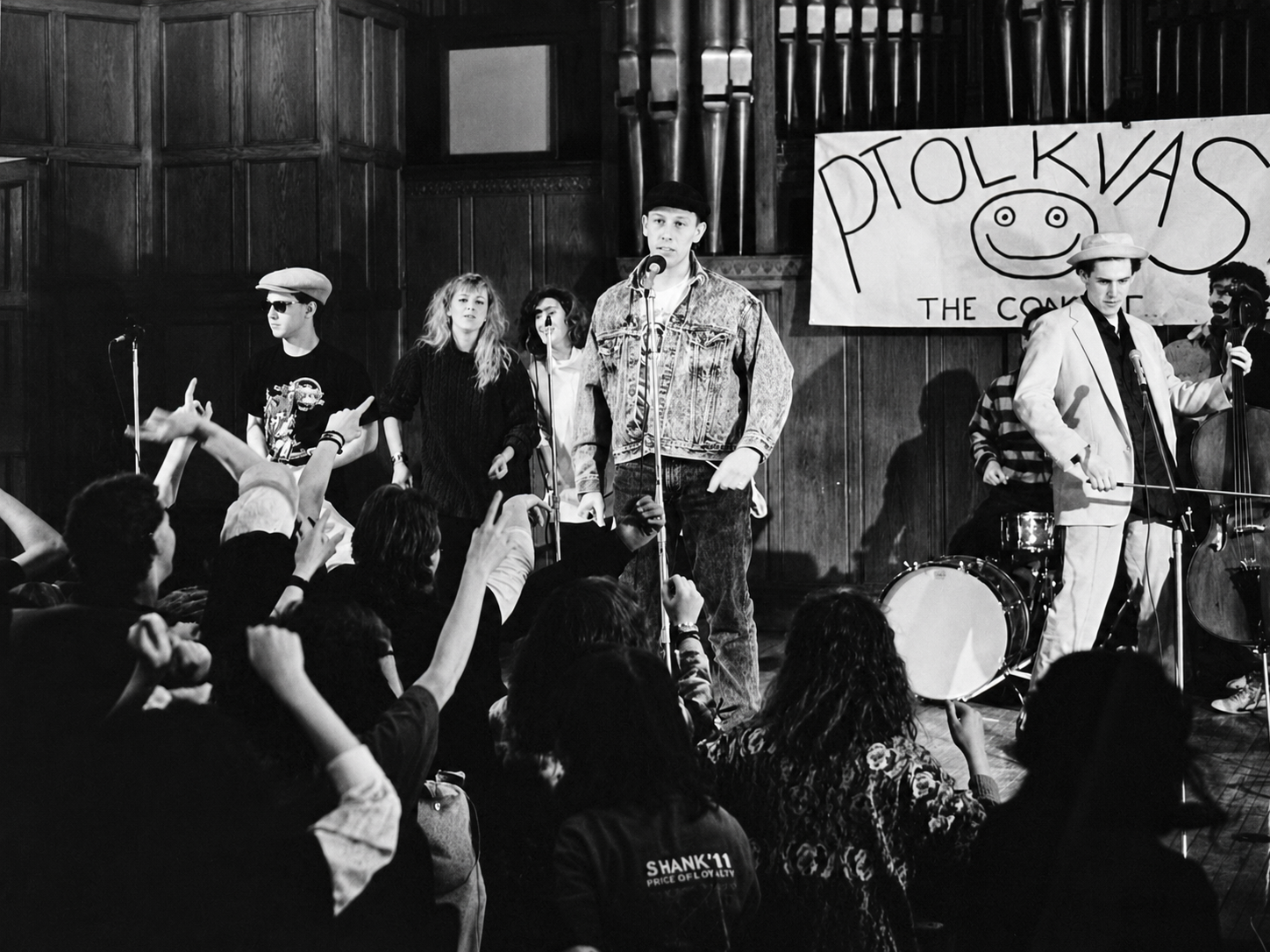
Again, theatrics could stretch into many forms. Audience-participation radio sketches. Scheming peer dares for a charity fundraiser. Leading a mass silly-walk of several dozen dorm mates (quietly) through the university library. Experimental multi-media performances. Spearheading a notion-to-activation collective, bright-as-day-illumination of the dorm across the street (sparking an annual tradition for 15+ years). Generally: amassing ample credits for an as-yet-unaccredited minor in applied amusement.
More officially, Darren earned entry to the two-year Creative Writing for the Media program, where he wrote his first screenplay– through the tutelage of Julia Cameron (as she was writing The Artist's Way). After learning from MacArthur Genius Grant-receiving director and playwright, Mary Zimmerman, he proceeded under the mentorship of renowned playwright, Charles Smith, and wrote his first one-act. Potlickers soon made him an "award-winning playwright," garnering Northwestern University's Agnes Nixon Playwriting Award. The prize facilitated the profound "life moment" of a staged reading, delivered by a top-tier cast including a future Tony-winning director and Tony-nominee for Lead Actress in a Musical.
Throughout his college years, Northwestern and its Chicagoland placement brought abundant opportunities for live theater, where he found his comfort zone in coursework and off-stage capacities, mostly among the audience. About five minutes into Les Miserables he gained clear understanding of what all the fuss had been about--and performing excellence. Decades later, with the added evidence of repeat seatings, he continues to place Les Mis in the highest position on his Rushmore of admired creative collaboration achievements.
Not as lofty: Silverman Axed, the Casio-heavy, album-a-night improvisational band he formed with his roommates and guest performers. Beyond playful experimentation, marveling at the composing and performance talents within his friend circle, a course in Beginning Voice, and developing songs for his video ventures, Darren's musical breakthrough came when selected as director of his program's annual extracurricular "big production," an original rock opera.
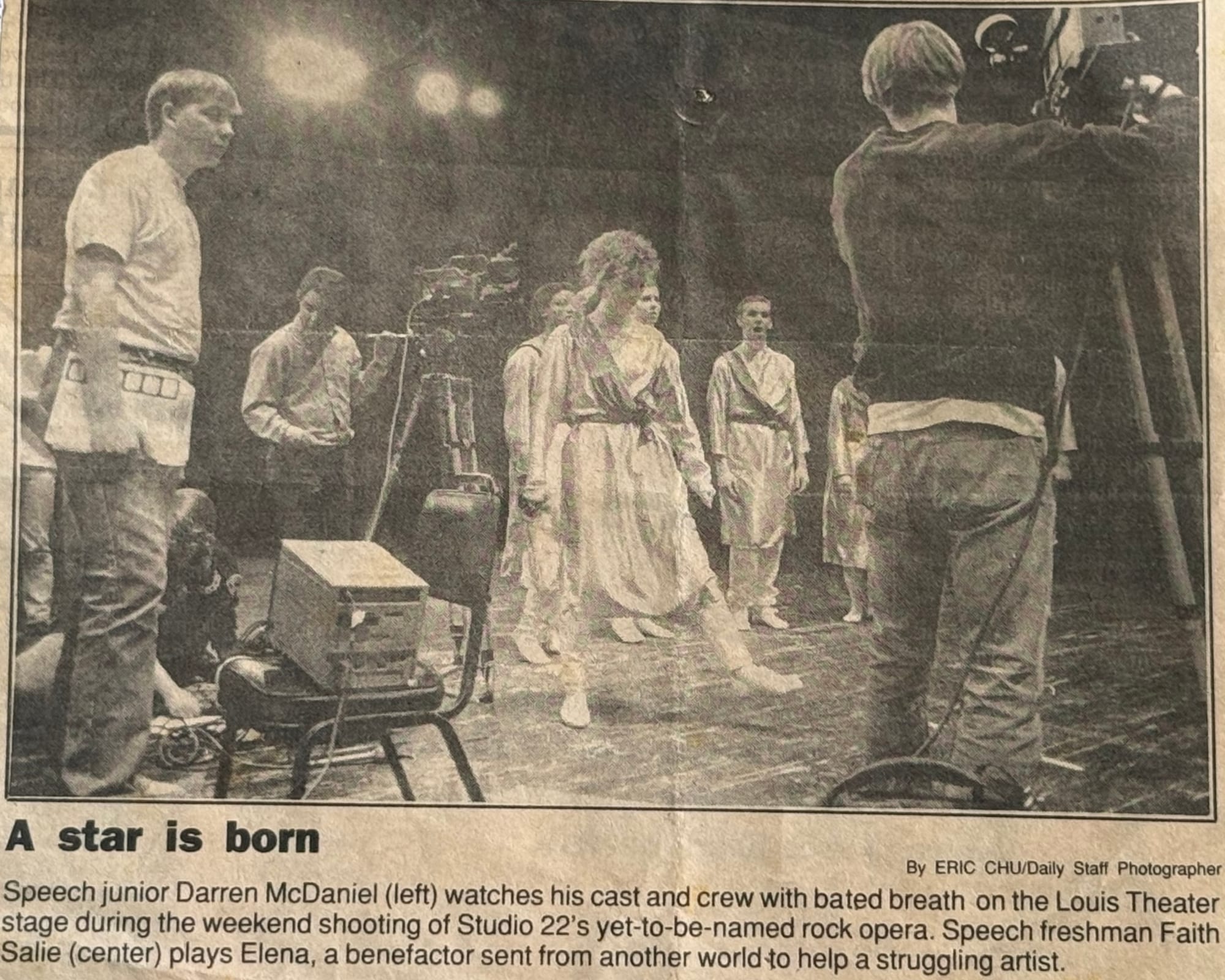
As a rock opera, Perfect Harmony's development opened an intimate, active window into the process of crafting songs within the confines of scenes--in a manner that held together cohesively, yet with dynamic tonal shifts. It also generated Darren's first extensive recording studio experience, where he contributed vocally in addition to as a director (as pictured above and atop this page). Leveraging a Student Emmy and other award earnings, he and the producer returned to the studio with a co-written original duet and music video, for which Darren also sang the male lead.
Studio recording of "The Ballad of Hank and Mildred" (1991), footage courtesy of JoEllen Ruvoli.
A summer in Los Angeles, where he interwove an internship in Entertainment Tonight's tape vault with cashiering in a hardware store to the stars, was enough to let him know that his entertainment media career would need to arise outside Hollywood. Upon graduation--into a recession, no less, his return to his Florida base crash-coursed him in after-college realities of over-exuberance meets underemployment. With a siphoned collaborator pool and a stark reduction in resource access, Darren found himself in "the gap," an experience that would later inspire social theory, civic actions, nonprofit initiatives, and his philosophy toward teaching.
Channeling his creative drive inwardly toward crafting screenplays, his piecemeal vocational forays began to take on the feel of his new favorite book, Studs Terkel's Working. Temporary odd jobs and substitute teaching (at every grade level) gave him windows into others' worlds--generating "writer's material," galvanizing his sociological perspective, and gearing his empathetic ear and eye toward human plights and stories. Still, it pulled him further from his intended career mission without a focused alternative, a divide that prompted his return to college, as a southern U.S.-focused writer/documenter in an interdisciplinary degree...marked by ready-made room to pivot.
While WIN may be Darren's first completed musical, it is not his first attempted musical. His 1992 campus-visit road trip to Oxford, Mississippi and a handheld tape recorder sparked him into a "city woman meets small-town mechanic" story, with maybe 4-5 partial songs.
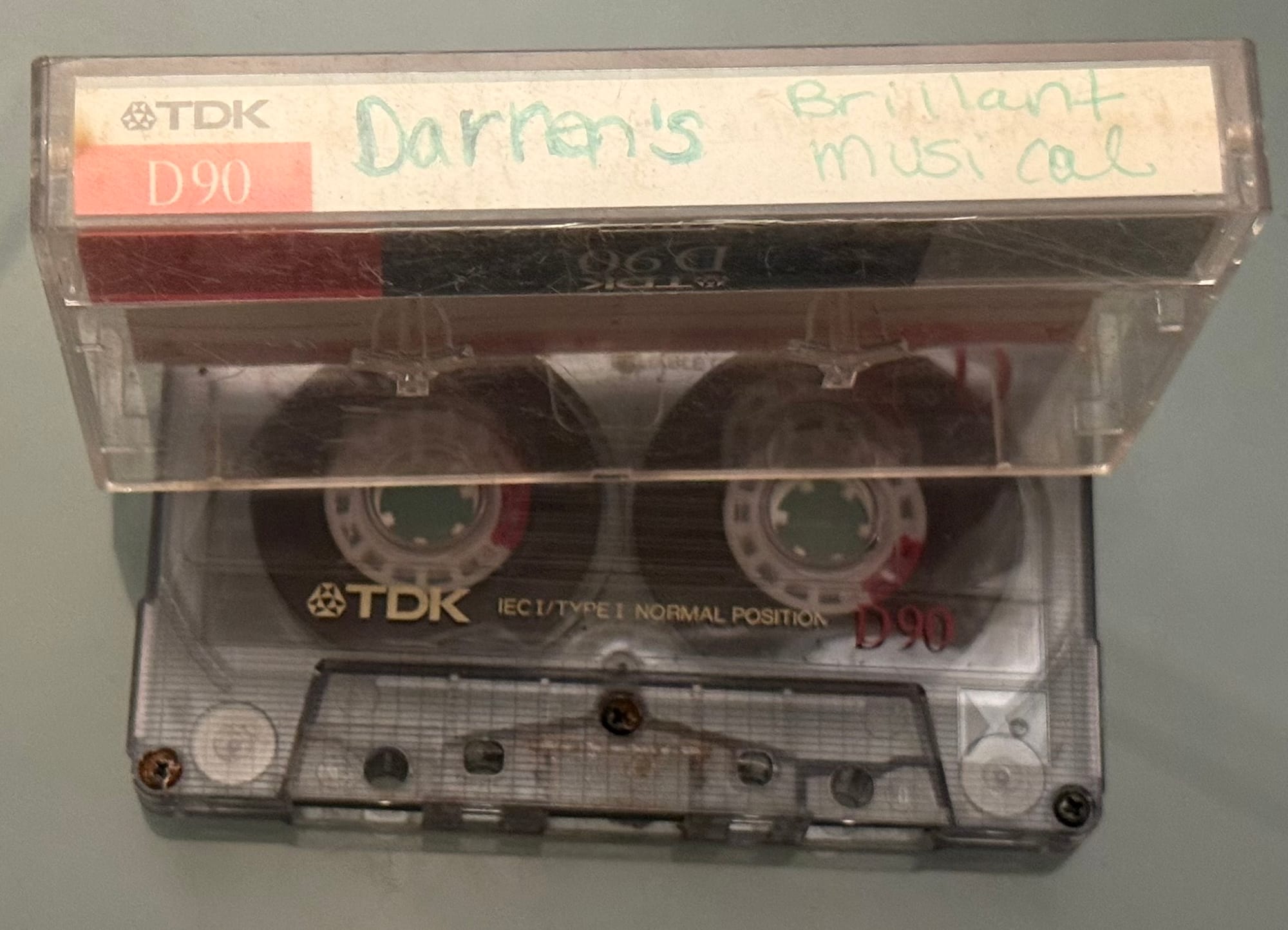
The ally-labeled cassette remains as provenance, condition sketchy, so not played, though he still recalls a few melodies, including that behind an opening verse:
Mississippi highway... Running on a spare.
Left Pittsburgh at sun-up. Now we're almost there.
Grad school paused side creative ventures, though it got him back on a flourishing, self-actualized track. In a moment of life-altering impact on par with his Ford Museum stop (and nearly precisely 30 years prior), he went to the University of Mississippi's carpentry shop to get keys for his campus job. Here, he discovered the workers of the university's Physical Plant, on a lunch break, pitching washers. Henceforth, he returned regularly, a fascinated participant-observing sponge, alive amidst the colorful characters and banter-rich dialogue he'd aspired to craft, fictionally. He soon began scheduling sit-down guided interviews, again with his tape recorder, often shifting to ride-alongs, as the workers shared the wholeness of the campus experience from their vantage points.
In the work of studying work lives, Darren found an emergent rush of connection to his own biography, juxtaposing the dynamics of working-class vocations along his paternal side with the academic path of his librarian-educator-turned-lawyer mother. Beyond packing a full thesis and Master's into a calendar year, his time in Oxford cemented his identity as a sociologist, dialed in his continuing connection to Americana music, generated a Graduate Paper of the Year award, and even sparked the superfriendship that, nearly 30 years later, would spur the Ford Presidential Museum adventure.
An offer to support his continued studies at Vanderbilt prompted a graduation-day move to Nashville, where he anticipated furthering his explorations of work, culture, and southern regionalism. He found writer's resonance in the notion of the "sociological imagination" and the idea of understanding personal plights in relation to the socio-historical conditions that shape them. The dramaturgical, life-as-performance approach of the works of Erving Goffman strengthened his inner playwright, too--and even worked its way into the Elements of Drama summer course he taught through Johns Hopkins to middle-schoolers.
Ultimately, social psychology proved his sweet spot, making space for the power of individual agency within systems and structures. As a growing focus on theories of identity ("Who am I?"), particularly as tied to work life and careers, drew Darren's academic attention, it also played personally. When it came time to choose a dissertation, the serendipity of being in Nashville led him to studying Music City's striving musicians. Though absolutely ideal as a research focus, side effects included rising tensions of feeling as much a shared sense of calling with those he was researching as with his fellow academicians.
The dive into live music, singer-songwriter showcases, music production energies, and conversations about creative pursuits began to spill into his own career considerations and invite further immersion.
Attending meetings of the Nashville Songwriters Association International began to feel like double duty: fieldwork on one level, orientation on another. More and more, his notebook pages' theoretical ruminations ceded space to lyrical explorations.
You've got another thing comin' --
So, maybe, I should go.
Yet, even with his Master's degrees in Southern Studies and now Sociology, a mind for Americana life, and a wordsmith's tradecraft, writing toward country radio proved to be past the scope of his priming in that season. He pivoted his attention--not back to his dissertation but back toward his waiting calling of writing scripts for the screen.
Nearing completion on a long-abandoned passion project, he set a date and invited friends to participate in what would be its debut reading--a gathering offering revelation of self as much as story. "This is who I am." The shared readings became a practice, repeated, also with other scripts--each occasion furthering a reclamation of self, and purpose. The fruits of his beloved research, ironically, ennobling a pivot away from its pursuit.
As Y2K closed, Darren's completion of a brand new screenplay coincided with a three-month consultancy opportunity back in Orlando. Seizing the moment to fulfill his filmmaking dream, Darren paused his studies ("Just a pause" 🎶)--and made the move, returning ("Back and forth again" 🎶) to his native Florida, to direct a feature...set in Texas.
Pulling together a talent tapestry of friends (from his universities and schools as far back as fifth grade), family members, and newfound forces, Darren found factual community in the grassroots conjuring of a fictional one. From the challenge stack of staging street-closing parades to the resonant triumphs of recording its soundtrack, filmmaking pulled him back into the kind of sprawling creative problem-solving in which an imagined world only became possible through the dynamic, activated talents of those involved.
Four years later, his indie-epic "alleged documentary," The Essence of Irwin, premiered at Chicago's Gene Siskel Film Center.


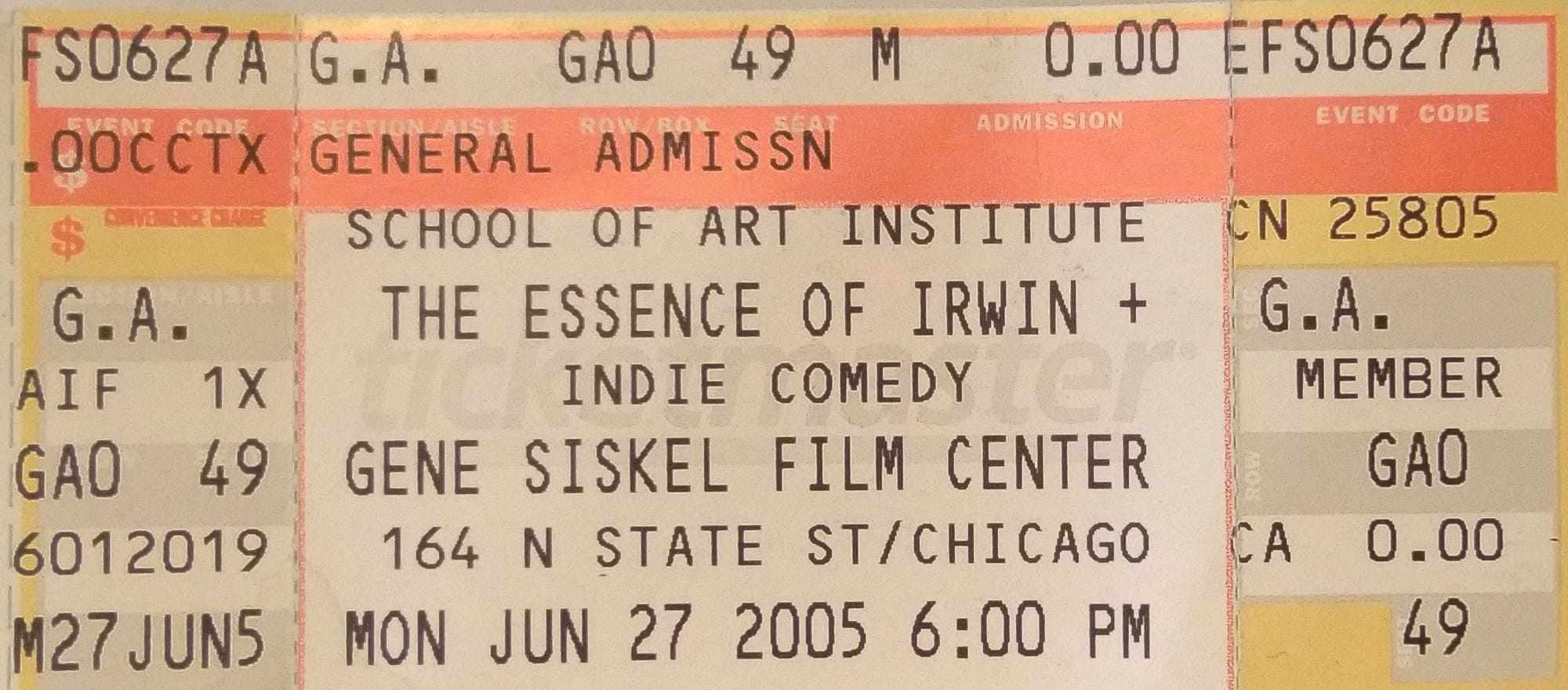
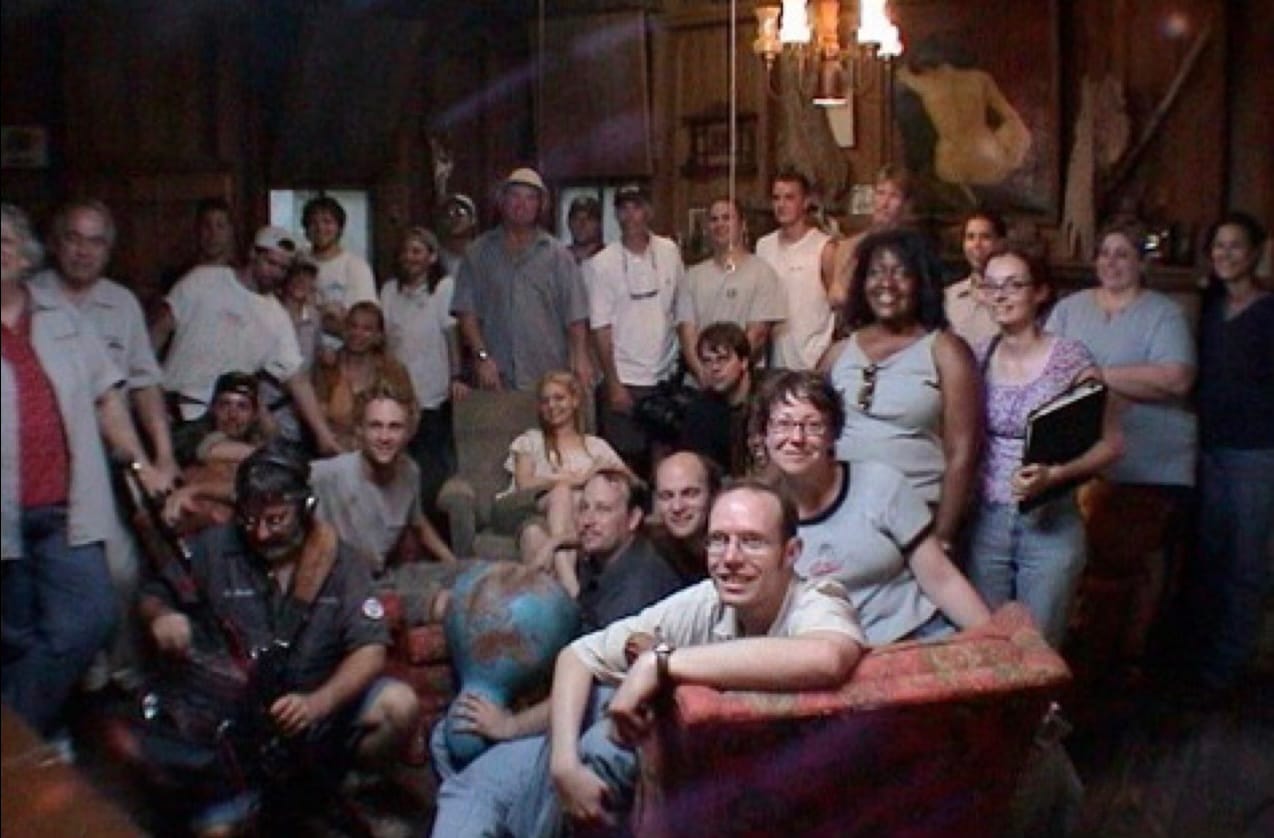
Essentially: Irwin. While not presently streamable, Irwin remains at the ready for a modern-era revival.
In process and product, Irwin embodied Darren's signature quest: imagine an improbable improvement, gather people with different gifts, and watch the thing become far better and more real because they entered it. The Utopia of his dorm--recognized in reflection, fortified by sociology, realized in re-creation.
Increasingly, Darren became interested in how such conditions might be generated deliberately and systemically--for creative endeavors, for classrooms, for organizations, and for communities.
He was moved not only by realization of vision but by the arc toward its achievement--from the spark of possibility, carried, through process, to ultimate fulfillment. Fulfillment sweetened by the steepness of the climb, the measure of improbability and idealism, and the company of collective contributions. Sought and found, beautifully, in achievements far beyond his own.
Which brings us, improbably enough, into the White House, 2009. Lin-Manuel Miranda's "Hamilton Mixtape" performance for the Obamas.
Having discovered the video after seeing the Tony-stage Hamilton performance, Darren found himself overwhelmed, moved to weeping as he played it for his partner. Awash in exuberance for the arc of achievement, the beauty of process, the vulnerability of grand reveal, and the evidence of imagined possibilities becoming epic realities.
That alone, in the words of Hamilton, "would be enough." And yet. Revelations since continue to add to its historical and biographical abundance. Here was not just a creative work but a work of musical vibrancy--one refreshingly re-presenting America through an under-considered historical figure.
And then, there was a further discovery. Thirty-five years earlier, for the first and only time, a new, unelected President had taken the oath of office inside the White House. The East Room. Written into WIN. "What if...the room where it happened was the room where it happened?" The very same, as it happens.
An emblazoned memory--its meaning still compounding.
"Every moment a museum." 🎶
eXperience Generation
Darren's first fully-written musical, WIN joins in a multi-modal, omni-diverse compilation of Darren's catalyzed ventures. Books. Poems. Scripts. Curricula. Business plans. Gatherings. Web worlds. Systems. Community hubs. A micro-school. Rooms full of people who might not otherwise have found one another. United as experiences designed toward whatever might help people encounter an idea, one another, or even their own capacities differently.
As a university faculty member, Darren developed, directed, and delivered courses in digital storytelling and creating brand experience, professing with several thousand design students over eleven years. His instructional design treated curriculum less as information delivery than as an unfolding purpose-packed encounter. Students did not simply study story and design principles; they made them, entered them, tested them, and considered how every choice--"every pixel of every frame"--presented opportunity and responsibility for them as designers, opening possibilities to shape what another person might see, feel, understand, or do next.
Beyond the classroom, Darren developed a model he came to call opportunity structures: flexible frameworks for connective engagement. Intentional cross-weaves of people, place, ideas, and possibility. Orlando's Urban ReThink transformed a former downtown bookstore into a community hub for artists, entrepreneurs, educators, thinkers, and civic imaginers—people whose paths might never otherwise have crossed, gathering within a space designed to encourage collisions of purpose.
Sometimes those structures leaned toward the earnestly consequential. Sometimes they involved adults making and/or mounting broomstick ponies in a fun-raising street race. Produced twice, the Broomstick Pony Derby turned an imagined absurdity into a participatory public happening--complete with crafted identities, pageantry, competition, and the willing suspension of conventional dignity. Like many of Darren’s projects, its premise began with some version of “What if…?”--this one posited by a friend--and advanced through the less glamorous questions required to make the improbable real: What must be built? Who could join in making it happen? What will invite participation? What might make people care?

The instinct to recognize an undeveloped possibility and gather the collaborators capable of giving it form also brought (larger-than-) life to GoogliAnn, a working-googly-eyed mural that began with the self-portrait of Darren’s six-year-old niece. Through the added artistry of a muralist and the ingenuity of a technologist, a child’s imagined rendering of herself, enlarged and activated beyond expectation, became architecture, character, collaboration, and experience. Conceived privately. Realized collectively. Encountered empoweringly.
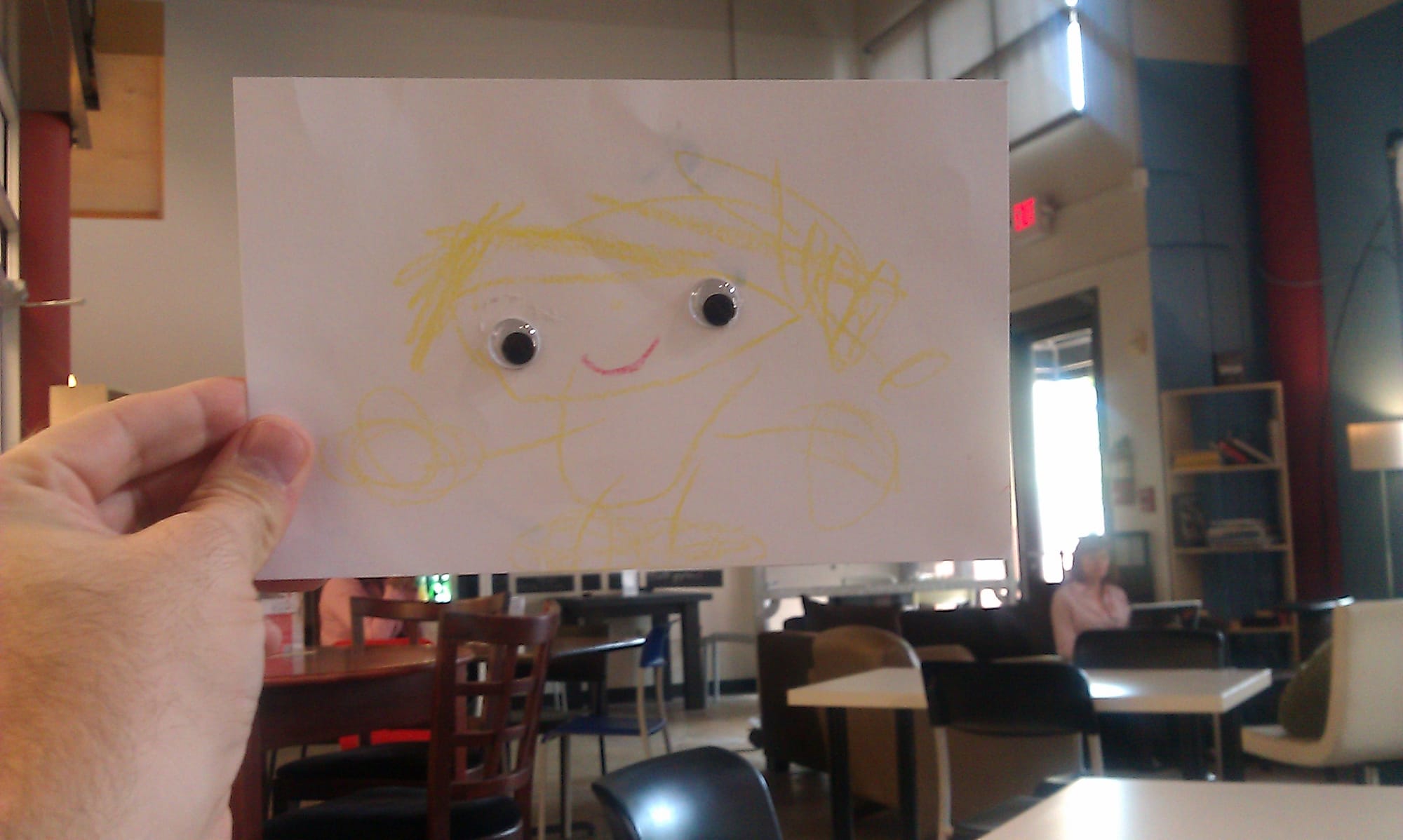
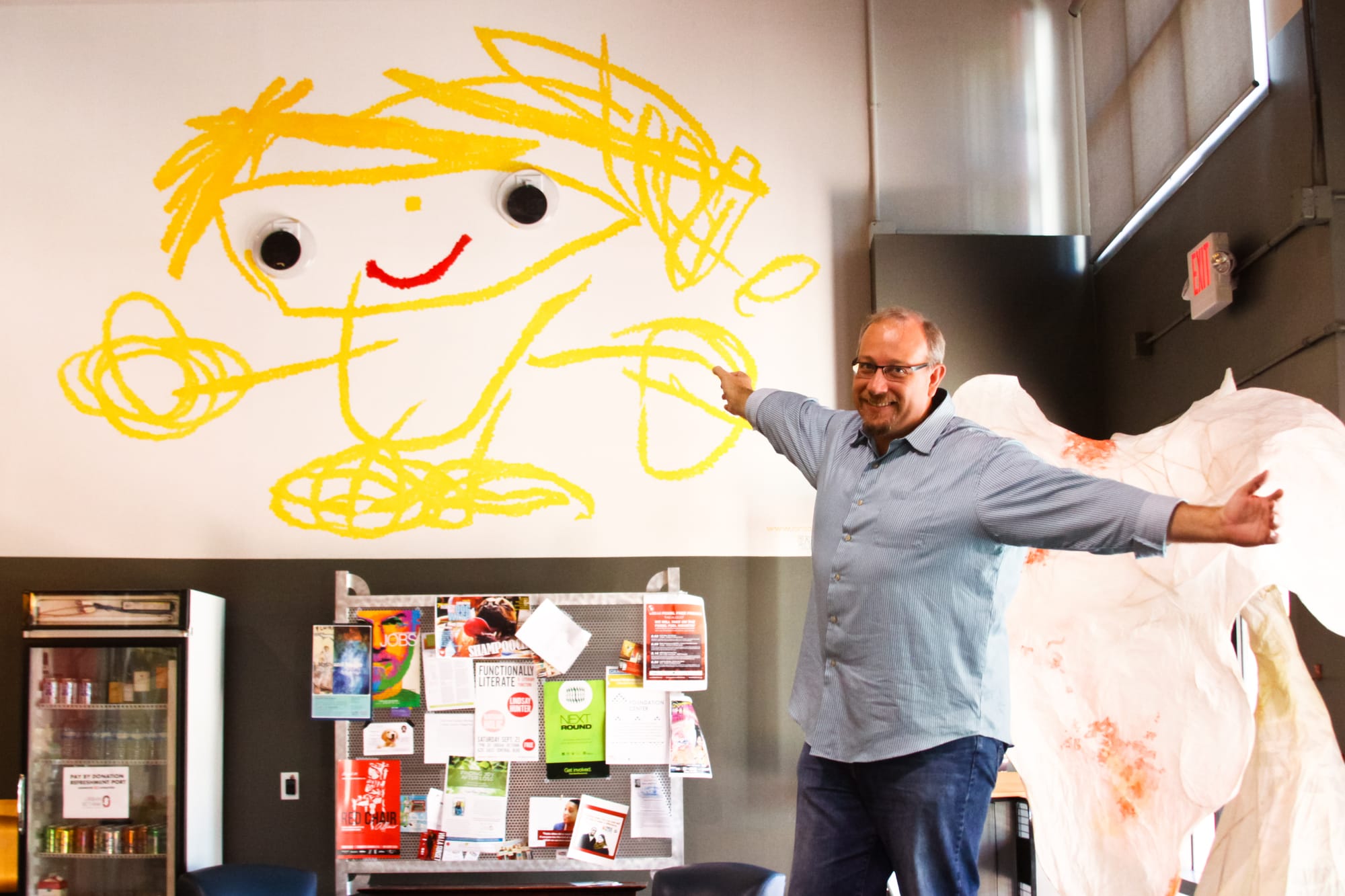
1. Imagining... 2. Real! (Photos by DMcD and Tisse Mallon.)
More than the official title of the mural, The Audacity of Play represents play as one of Darren's go-to entryways to ideation--whether with spaces, people, characters, concepts, or, most frequently, language. For Darren, wordsmithing blends play with the challenge of crafting precise audience-tailored terms and phrases with intentionality of purpose. After all, when the needed word doesn't seem to exist: What if it did?
Suggestaurant. Gappers--and gaptitude. Devicive. Anxietgeist. Optimologist.
Design: Language. Breaking an expected pattern with a turn in cadence. Finding a word carrying two or three entendres. Offering alt-spellings or novel juxtapositions of meanings to prompt fresh considerations. Regularly fending off autocorrect to preserve epiphanies before they're yanked. (Spellcheck, mate.)
Across terminology, classrooms, community spaces, public happenings, films, and stories, Darren kept returning to the same generative act: seeing what wasn't quite there, imagining what might be, and finding the people, forms, language, and persistence to make it real enough for others to enter.
Threshold
By October 2, 2023, Darren had built a life of writing, listening, directing, teaching, researching, convening, and building connective experiences. Over the most recent decade, he'd channeled much of that toward internal projects in support of his employer, where it began to bog down in institutional gear grinds and accumulate, unrealized. Meanwhile, the national moment had grown more volatile, with increasing--and increasingly unnatural, he observed--tilts toward outrage, animosity, and divisiveness.
Darren had broadly learned to approach lives as stories, institutions as stages, public places as invitations, experiences within--and beyond--their moments of happening, and possibility as something that could be designed, mined, and cultivated. Yet, by 2023, his civic voice had drawn silent; his community-building more insular; his attention toggled toward intake and contemplation.
An August opportunity to pull the body of his work together for a pitch to his employer--for a venture teeming with national impact--brought it all to the table and to the surface, reigniting interconnections and conviction in its assembly.
The exercise also clarified a harder truth. Darren had spent years hoping institutional stewardship might eventually open space for aspirations increasingly central to his own sense of purpose. By the pitch’s aftermath, that faith had largely run its course. Whatever came next would need to move beyond waiting for someone else’s priorities, permissions, or promises to align--releasing his attention to pursue the work, relationships, and possibilities he could actually move.
Encountering the Gerald R. Ford Presidential Museum six weeks later, anything was possible--including the most-probable usual gloss-over of the experience as it washed into the swirl of life, with the occasional bonus of a resurfacing recollection.
Museum exhibits seed considerations through facts and artifacts, annotations and frames, images, insights, and juxtaposition of elevations and humanizations. Yet Darren's irony is that, for him, the connection came to life--and live--as much from the pre-seedings as the exhibitions of curated content. The almost-didn't-make-the-stop lead-in indifference. The imperative accompaniment of a life-pillar friend and fellow humorist, educator, interdisciplinary learner, creative, and mindful observer who brought his own keen eye for observation and angle. The upon-arrival exterior arrangement of welcoming statues ("an astronaut?"). The absence of later-to-be-added stanchions around Betty. The modestly-positioned Gerald. The architecture of large, reflective windows--and the held mystery within a glance-up at the second-level overlook.
All culminating in activation, not as much in the during but in the after. In the drive away, in the continued musing, in looking back and seeing differently. Impressions took root. Connections surfaced. A former President's life--seemingly low on charismatic dynamics, non-attuned to its observer, and resistant to musical treatment--began springing forth lyrics, melodies, scenes, and an increasingly persistent conviction: Darren's need to present--to represent--Gerald Ford, as a musical. And right there was Betty at his side, hand outstretched, in, too, for the dance.
Darren's Act I had prepared him not merely to write a musical.
It had prepared him to recognize one as it began to grow.
So this Act I's closing number would be the gateway to his Why. Why this particular story for this particular author at this particular time? What made it personal? Lit the spark? Tipped the point?
Questions answered most directly by a facet as yet unmentioned, something as unsuspected to those in his earlier decades as the span of his creative scope might be to those in his latest one.
Parenting. The step to his giant leap.
Despite being a "Junior," Gerald Ford hadn't started life as Gerald Ford. Despite being a "Senior," Gerald Ford, Senior, wasn't "Junior's" biological father. The human hook. Encountered a decade into living as a nonbiological, unofficial parent of two. Co-raising another person's "Junior," as it happens. And there it began. Personal. Spark: lit. Point: Not yet tipped--though merely a step away.
Intermission
Epiphany: Step-parenting kindredness raised awareness of that aspect of Darren's identity, yet it was the practice within the role of his own step parenting experience that "sealed the book."
"Declarity" is Darren's coined term in WIN's opening number. Stating something with sufficient confidence to make it undisputedly and simplistically so (even when it's not). All the trickier when the object of the statement is a complex human being. As he explains, going around waving the wand of declarity at all people, places, and things in your path may ease classification burdens but ultimately repels and rejects understanding.
Declarity confounded Darren and went against his grain. He'd often appeal to his own stepson's bouts of declarity with "The answer is rarely absolute and almost always 'It's complicated.'"
And yet, Darren's museum-exiting statement to his friend: "Gerald Ford was remarkably unremarkable."
Here, in his museum exiting summation of another man's life--one he'd just been offered a window into--Darren recognized that he was the one glibly declaring.
Reductively: Busted.
"Remarkably unremarkable?!"
Catchy? Yeah. Pithy? Perhaps. Fair? That would be for reflection to unpack--not just in reconsidering Ford but in reconsidering "remarkable."
The junior Darren helped raise became part of what compelled him to understand the Junior Gerald Ford Sr. raised--and the process of his own parenting sounded his own alarm that a complex person cannot be adequately captured by a passing declaration.
Act I: He hadn't written a musical. Wasn't planning to write a musical. Didn't dare claim to be a musician. But he was prepared to write a musical.
Gerald: Sounds familiar.
Dramaturg: An accidental musical about an accidental president?
Betty: What if it wasn't an accident?
Dramaturg: When the compilation of circumstances planted the opportunity, not only was he prepared to write a musical, he was particularly prepared to write this musical.
Betty: Because who writes a musical about Gerald Ford?
Dramaturg: And what within him then made writing a musical about Gerald Ford such a driving need?
Act II: Recognized: Compelled to be Propelled
When a writer endeavors to place another human's life at the centerpiece of his or her own, without the luxury or possibility of direct conversation, it doesn't hurt for that person to have once been President--especially one with such a well-documented life--from his mother's earliest scrapbooks to the national archives and his own full Presidential Library.
It doesn't hurt that books have been written--books such as An Ordinary Man, the definitive biography on Ford--written by the Museum and Library's former Director (Richard Norton Smith) and published just six months prior to Darren's Museum visit.
It doesn't hurt for the writer to be a trained researcher--an analyst, with a nose for nuance and an eye for story. Being 1200 miles away could, arguably, hurt, though in the age of the internet, Darren used the distance to advantage, expanding and imaginatively reencountering his Museum visit through its ample online archive of write-ups, timelines, and photos.
Fortune combined an abundance of what had been represented with an abundance within the life represented. Through themes, factors, and shaping events. This was a President who'd lived, literally and figuratively, an All-American formative journey, one that, it turns out, was refreshingly relatable to Darren's life and lens.
In discovery, Darren would be especially driven to find the fascinations. The gems and clasps. Aspects of added magic with dynamics that resonate within the discoverer--compelling the tell and propelling the teller. Some among them:
Born "a King"... Raised a President
Junior--Senior
Divorce and diverted families
The many departures and returns to Grand Rapids
The Remarkable Betty
The unremarkable "WIN" campaign--with buttons and a theme song composed by the writer of Oklahoma!
His life quest: To be Speaker of the House
The House vs. the home
1976--Bicentennial Presidency
Ford's deep, post-presidencies friendship with Jimmy Carter
Character: Modest. Humble. Kind. Decent.
An unexpectedly poetic abundance. Here, primed, for someone readied to see story--from nuance through to themes--and translate it theatrically.
As a musical writer, Darren, especially, would be drawn to look for pithy turns of phrase these might invite--familiarities and relatable truths that hold a surface dynamic that can be furthered when served with a twist.
Jerry/Jimmy, Betty/Bet He, Ford/Lincoln
Grand Rapids, Michigan
Mashups of Oaths--Boy Scout and Presidential, Hails--to Michigan and the Chief, and Contests--Football/Elections lingo
Steps
Betty working at Herpolsheimer's--how could such a word not be included in a musical under Darren's development?
Ford's life kept handing Darren the kinds of materials his mind already liked to work with: juxtapositions, echoes, double meanings, competing frames, historical callbacks, linguistic collisions, and opportunities for reprise.
Discoveries delightful in form, yet it would ultimately be their content that kept firming the linkages, deepening the fit, and revealing the fullness of Darren's readiness: combining his familiarity with the story-sharing vessel with the life matters primed to be poured into it.
Subject Matter Exper-ience
For Darren, the material's accessibility extended beyond its availability and into the pathway of his own life. Though more often as dabbles than as depth, Darren could relate with lived familiarity to Ford's areas of activities, deepening the subject-writer bond while also reconnecting the author, warmly and welcomingly, with his own biography.
Foundationally, both grew up within the felt love of family, eldest siblings, immersed in the boosting care of adoring (and adored) parents. While Darren didn't directly experience Ford's blended-family dynamics as a child, they would become fundamental to his adult family-life experiences.
Growing up, though certainly earning his "playing outside" merit badge, Darren's official scouting experience was more Cub Scout than Boy Scout. Still, he did just enough of the latter to "Be Prepared" to write about the scouting spirit and recognize the core principles in Ford's ways of being.
Darren loved pick-up sports and extended that to team sports including high school basketball. Unlike Ford, his tackle football career ended without a game played, after just a few weeks of junior high preseason practices. "Just finish what you started," his parents said, "and then you can quit." His appreciation for the sport first surfaced, fittingly, in 1976 with the debut of his hometown franchise: the Tampa Bay Buccaneers, whose 0-26 start firmly planted his affinity with underdogs.
Elementary school in Tallahassee brought frequent attendance at Florida State and Florida A&M games, with the latter's "Marching 100" world-class marching band leaving an imprint that presently shapes his aspired arrangements for WIN's funkier fare. He vividly remembers his Mississippi-raised father bringing him and his younger sister to the Tallahassee airport to cheer the Florida A&M football team upon their championship-clinching victory. He suspects that moment carried all the way through to his encounter with the Ford Presidential Museum's exhibit on the Civil Rights angle of Ford's football playing days...material he'd begin working into lyrics and melody the following afternoon.
Darren, himself, roamed the college football sidelines, running camera cable for extra income as a University of Mississippi grad student. Plus, as it turns out, Ford and Darren took the very same field--and at the same age, 56 years apart. Gerald played a game at Northwestern's Dyche Stadium, precisely where Darren tackled staging a stadium concert scene for his first big video production.
Darren didn't work in a family paint store, though his grandfather had a family appliance store that would shape the careers of Darren's father and uncles. Relatedly, Darren did summer stints with an air conditioning and refrigeration supply wholesaler (in tandem with overnights as a DJ) and then the aforementioned hardware store. They'd also both had summers of food prep. Darren was never a park ranger...unless you count Ranger Rick magazine.
While Darren's military explorations never advanced beyond a visit to the Naval ROTC offices, it was his Air Force veteran maternal grandfather who gave him most of his naval-ways training, which was more scrubbing than steering. And now, the junior Darren helped raise serves in the U.S. Coast Guard, adding a fresh and active layer of maritime resonance to Darren's Ford connection.
Like Ford, Darren went to law school. Unlike Ford, it was by association, only, and most often in the snack and study area, accompanying his mother's law school journey during his third-fifth grade years and then later picking up the language and culture of legal practice.
Darren's political career started about like the Buccaneers' franchise, stacking losses for class officer elections in each year of high school. (It gave him opportunities to create campaign posters, at least.)
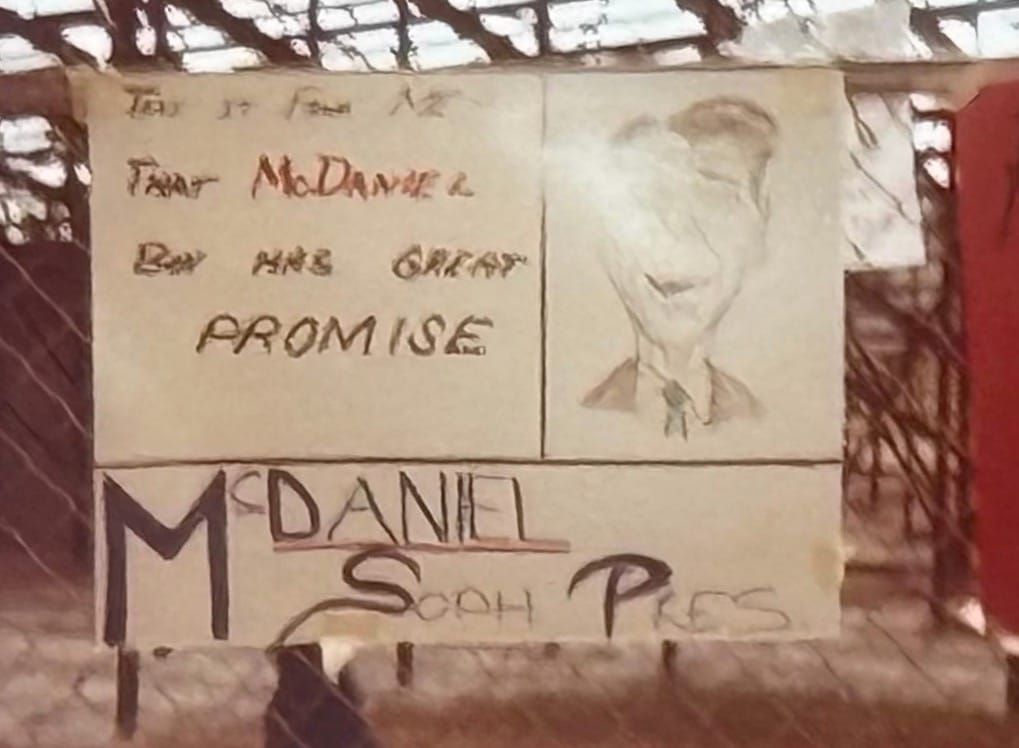
Fortunately, Darren's tally column shifted when elected to deliver the commencement address--from the 50-yard line--at his high school graduation. From then forward, he'd continue his winning streak, Ford-style, as treasurer and then president of his dorm and later as president of his two graduate program student associations.
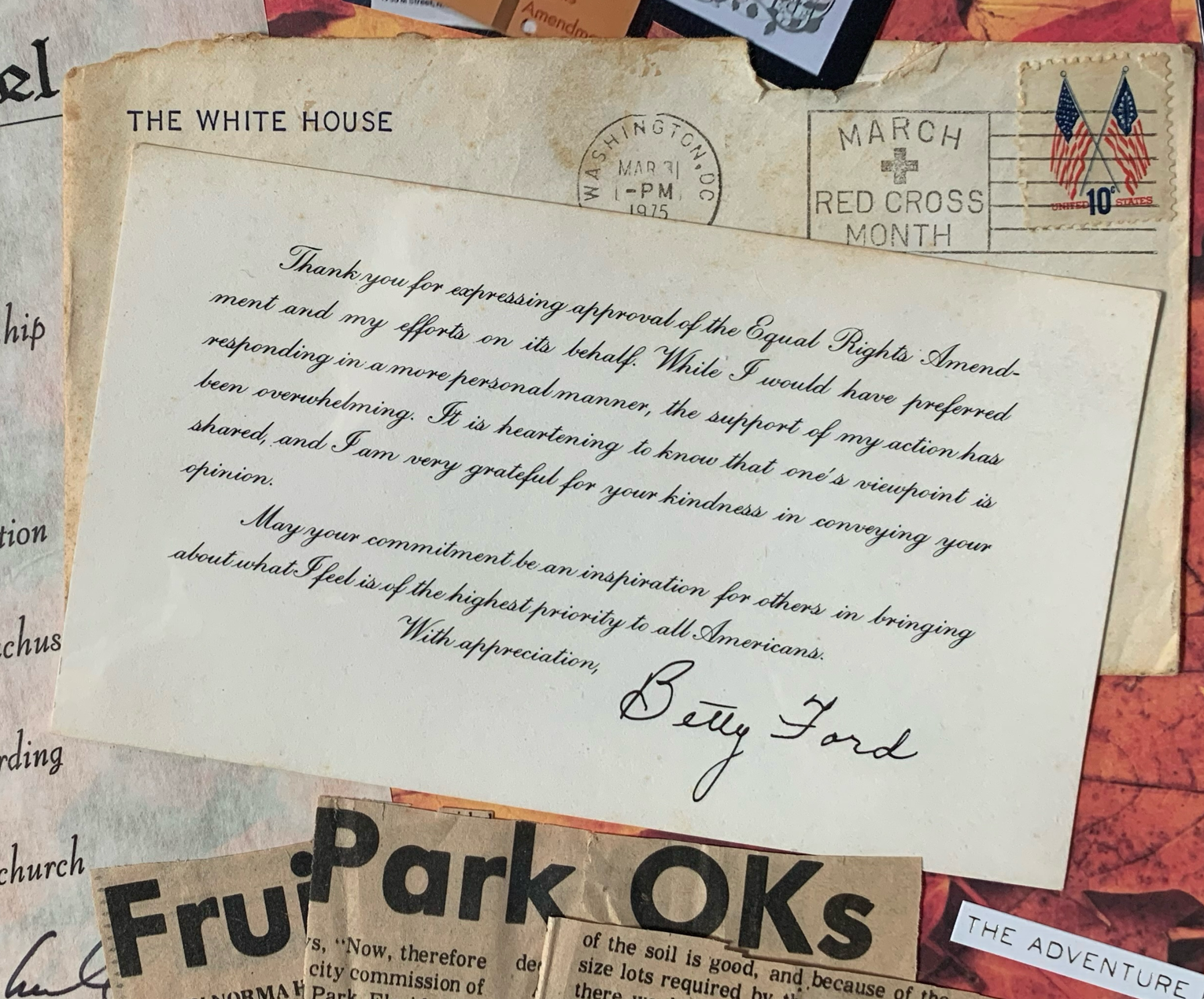
With faint recollections of watching the Ford-Carter debates now burned into WIN's later pages, Darren's first clearly-recalled political actions tie more directly to Betty. In early grade school, he helped his mother stuff envelopes in support of the Equal Rights Amendment. A couple months into writing WIN, his mother shared a picture of the front page of her career scrapbook, the center element being a letter from Betty Ford, thanking Darren's mother for having written her to express her support. Later, archivists at the Ford Presidential Library noted that they may even have the letter his mother had written the First Lady, though it would be in a vast haystack of unprocessed material. "If we get to Broadway, we can search for it then."
Outside of spending the summer before college working in the county clerk's office, Darren's civic participation skewed more generative than governmental--or electoral. Community building. Connective engagement. Designing and deploying platforms through which others might participate. Over time, civic framing entered his curriculum development as well, from his "Citizen Creative" collaboration training to key elements of the consideration-expanding initiative he'd been assembling in the months prior to his museum visit. Increasingly, though, the participation itself had moved behind the scenes.
By 2023, much of that outward-facing energy had narrowed. His civic voice had grown quieter; his community-building more insular. WIN would begin reversing the flow--not by sending Darren toward electoral politics, but by drawing him actively back into matters of American history and character, institutions and ideals, leadership and service, disagreement and common bonds, public memory, representation, and who gets represented, how.
And then there was the topper--the archived life. Like Ford, Darren was raised with a preservation of provenance. Baby books and scrapbooks. Artifacts. Pictures. Clippings. School papers and assignments. Stories within the pages and their compilation. Extending to archival video, edited productions, and printouts as access increased.
And, most notably, that whole thing with audio tape. (Fittingly, the item that his friend's daughter touted as the reason to go to the Ford Presidential Museum: they had one of Nixon's tape recorders on display.) From roadtrip ramblings to thesis and dissertation and ultimately composing WIN, itself, Darren's habit of using audio for collecting and preserving notions has cultivated a library of life-captures, ironically the subject of one of his completed screenplays. In WIN, Act One's "For the Record" threads recording terminology through the lyrics, a tribute. Fittingly, he quests now for his ultimate audio recording: a complete musical soundtrack.
Whatever the medium, Darren continues to collect and retain a full complement of artifacts through his own life course. Whether or not evidence of a subconscious museum-mindedness, it's a preservation practice that holds objects not just for their original significance but as offerings to future contexts that may well deepen and expand their meaning.
Reconsidered. Re-presented. Re-understood.
Closing Number
"Every Moment a Museum"
"Here's to Steps"
"Prepare to Be Prepared"
"Getting There"
Early-scene musical numbers within WIN. And the list goes on.
Gerald and Betty might say that the musical Darren has written is, in some ways, just as much a musical about Darren: the stepparent who raised another’s junior; the steadfast idealist; the celebrant--and embodiment--of the unremarkably remarkable; the collegial way-maker; the appellant to the nation, seeking to see and speak its values, character, and complexities more clearly.
WIN is a musical exploration of the wonders of reconsideration, sparked by a visit to an American presidential museum. Yet synthesizing and re-presenting one first couple’s lives also invited its author to reconsider his own journey: the scattered clues and seeds along the way, the long-separated threads, and the resonant reconnections that surface when seen within fresh framings.
There is wonder in convergence—in discovering how experiences that once seemed incidental, disconnected, or unfinished begin to make a wider, wiser sense.
Having read this far, perhaps you have already begun doing the same: imagining your own connection points; revisiting past experiences; curating; recognizing signs of who you'd become, alongside aspects of who you are presently becoming.
Seeing again with added whys. Broadened contexts. Fuller purposes.
Each human life offers its own museum, experienced by those living within it, moving adjacent to it, or afforded a window in. Its rooms hold what we inherited and what we chose, what we understood then and what we can only understand now– carried forward for fresh understandings and future observers. After all, at any moment, something may invite us to enter again, look more closely, and reconsider what we thought we knew.
Added Matters: Videos from the Vault
Talk delivered in 2012.
Join the Company
Want access to behind-the-scenes stories, first listens to new demos, Q&As with the creative team, and development updates? Subscribe for early, inside access to the unfolding story of the making of a musical.
Up for stepping up to help further? Visit our Support page to explore the many ways you can step into our harmonies and become part of the story--or click below to join our First 100 Fund.
